Increased efficiency in app development through specialized, reusable libraries

3. June 2024 - from Maximilian Lemberg
6 min read

Editor's Note: As part of his studies in iCompetence (Computer Science, Design & Management) at the University of Applied Sciences Northwestern Switzerland FHNW, our iOS developer Maximilian Lemberg wrote about the use of libraries in the development of native apps. In the following, we're making the article - minimally edited and supplemented - available to the general public. It provides a brief overview of the opportunities and challenges of using libraries, i.e. reusable and modular parts of code in app development. If you have any questions or exciting input on this or other app development topics: We always have open ears or inboxes for them.

And now enjoy reading!

Abstract

The constant demand for efficient and innovative software solutions presents app developers with enormous challenges. This article examines the importance of specialized, reusable libraries in app development. It describes the initial situation at Apps with love and the current challenges in software development, especially for recurring functionality. It explains how libraries can promote code reuse, simplify maintenance and reduce costs thanks to their modular structure. It also explains how an existing authentication library has significantly reduced the number of lines of code to be written in projects, saving time and resources.

The importance of efficiency in app development

Efficiency in software development, especially for mobile applications, is a key success factor. Developers must meet ever-increasing demands for functionality and quality, while resources such as time and budget are often limited. An effective approach to overcoming these challenges is the use of specialized, reusable libraries. They accelerate development processes and ensure higher quality and maintainability of applications.

The challenges of recurring functions in app projects

Many app projects require recurring functions that nevertheless often have to be implemented from scratch. A classic example of this is logins or the password recovery function - in principle, they always fulfil the same function, but due to specific requirements, they still often have to be customized. 

This leads to redundant work and a high level of shared code. Developers are forced to deal with similar tasks instead of being able to focus on innovative features. These recurring tasks diminish creative freedom and reduce efficiency. 

The use of standardized, reusable libraries helps to simplify some of these recurring tasks so that you don't have to start from scratch every time.

What makes specialized, reusable libraries?

Specialized, reusable libraries are collections of routines or functions that solve specific tasks efficiently. They offer standardized, proven methods for solving recurring problems without having to rewrite code for each project. In an analyzed paper, important principles for the development of libraries are highlighted:

  • Generalization and variability: Libraries should be developed in such a way that they cover general use cases and remain flexible enough to support specific requirements.

  • Design principles: Clear design principles ensure efficiency and maintainability of the libraries. This includes, for example, a consistent and meaningful naming scheme for functions, classes and variables. Precise documentation and standardized interface conventions are also crucial to ensure the user-friendliness of a library.

However, further work also emphasizes the challenges of reuse:

  • Poor maintenance or unclear documentation: This often leads to libraries not being used. Developers should carry out a careful review to avoid re-implementation.

  • Complex dependencies: These make developers reluctant to use libraries. Libraries should therefore be kept modular and simple.

Increased efficiency through standardized libraries

The reuse of code through specialized libraries saves development time and minimizes errors. The use of libraries significantly reduces development time and increases quality at the same time. In addition, libraries improve the scalability and maintenance of applications through standardized methods for recurring functions. The resulting cost efficiency leads to significantly reduced overall costs. Provided, of course, that the above-mentioned principles are taken into account when developing the libraries.

Use of authentication libraries at Apps with love

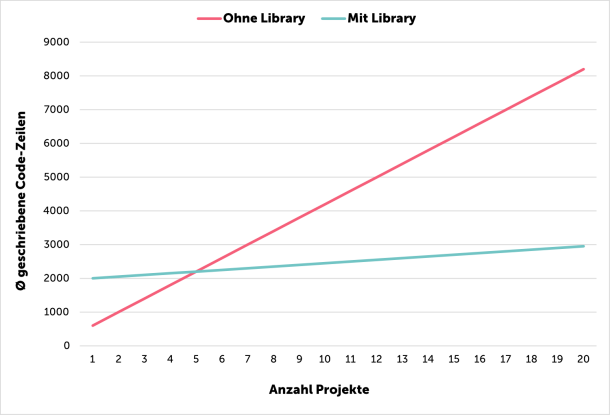
For example, the Apps with love development team has developed a specialized authentication library to simplify the authentication process. This library was designed to standardize and optimize recurring login processes, ensuring a reliable and secure user experience. The graphical representation shows that this library significantly reduces the number of lines of code to be written in projects by providing reusable routines that don't have to be rewritten in every project.

Graphic showing the average number of lines of code written with and without libraries on the y-axis and the number of projects on the x-axis

Strategic development of future libraries

Apps with love  plans to develop additional libraries that optimize certain recurring tasks. A planned error handling library will standardize error logging and management. An expanded localization library will centralize the management and updating of multilingual content in order to simplify the handling of translations. Such libraries can make the entire development process smoother and more scalable by ensuring consistent error handling and localization for all projects.

The standardization and simplification that can be achieved through the strategic development of libraries should enable developers to focus more on the development of innovative features that highlight the unique selling points of the apps.

Overall savings through reusable libraries

The targeted use of reusable libraries has significantly increased efficiency at Apps with love. By reducing redundant lines of code and reusing modular building blocks, developers can focus their creative energy on sophisticated features and innovations. This underlines the strategic importance of specialized libraries in modern development practices, as they reduce costs, improve scalability and optimize development processes.

Challenges and limits

Despite the obvious benefits, libraries aren't without their limitations. Challenges include specific project requirements, the complexity of large libraries, and reliance on outdated or poorly maintained tools. Compatibility issues with existing systems or dependency conflicts can also limit flexibility. Careful evaluation of libraries and their strategic use is therefore critical. Another challenge is to ensure that libraries are regularly updated and don't become obsolete. Development teams need to strike a balance between using established libraries and avoiding dependencies that could constrain the whole project.

The future of specialized libraries in app development

Specialized, reusable libraries are key tools in modern software development. They offer immediate benefits such as increased efficiency and cost reduction, but also enable sustainable and future-proof development practices. The future of app development will be characterized by an increasing specialization of these libraries. Development companies such as Apps with love will be able to react more quickly to market requirements and deliver high-quality products.

Sources

1. «Principles for writing reusable libraries», ACM SIGSOFT Software Engineering Notes.

2. A. Lampropoulos, «Mobile Application Development with reusable code».

3. «Why reinventing the wheels? An empirical study on library reuse and re-implementation», Empirical Software Engineering, Jan. 01, 2019.  

4. "Code reuse", Wikipedia.

5. «Library (computing)», Wikipedia

0:00
0:00